How Transformation Execution Gap — Between Strategy and Result — May Fail A Turnaround
A transformation does not create value when strategy is announced. It creates value when decisions, capabilities, behaviors and operating systems change—and those changes produce measurable results.
Many organizations begin transformation with a compelling strategy, ambitious targets and significant investment.
Yet somewhere between the boardroom and the frontline, the transformation loses momentum.
Priorities multiply. Ownership becomes unclear. Decision rights remain unchanged. Functions protect existing responsibilities. Technology projects advance without corresponding workflow redesign. Employees understand the announcement but not what they must do differently. Metrics continue rewarding yesterday’s behaviors. Transformation offices report activity rather than economic impact.
The result is an execution gap.
This research examines why transformation execution programs can lose value between strategic ambition and operational reality. It explores the role of leadership alignment, decision rights, resource allocation, accountability, capabilities, operating-model redesign, change adoption, performance management and value tracking.
The central argument is simple:
“Transformation is not completed when the strategy is announced. It is completed when the organization behaves differently and the business performs differently.”
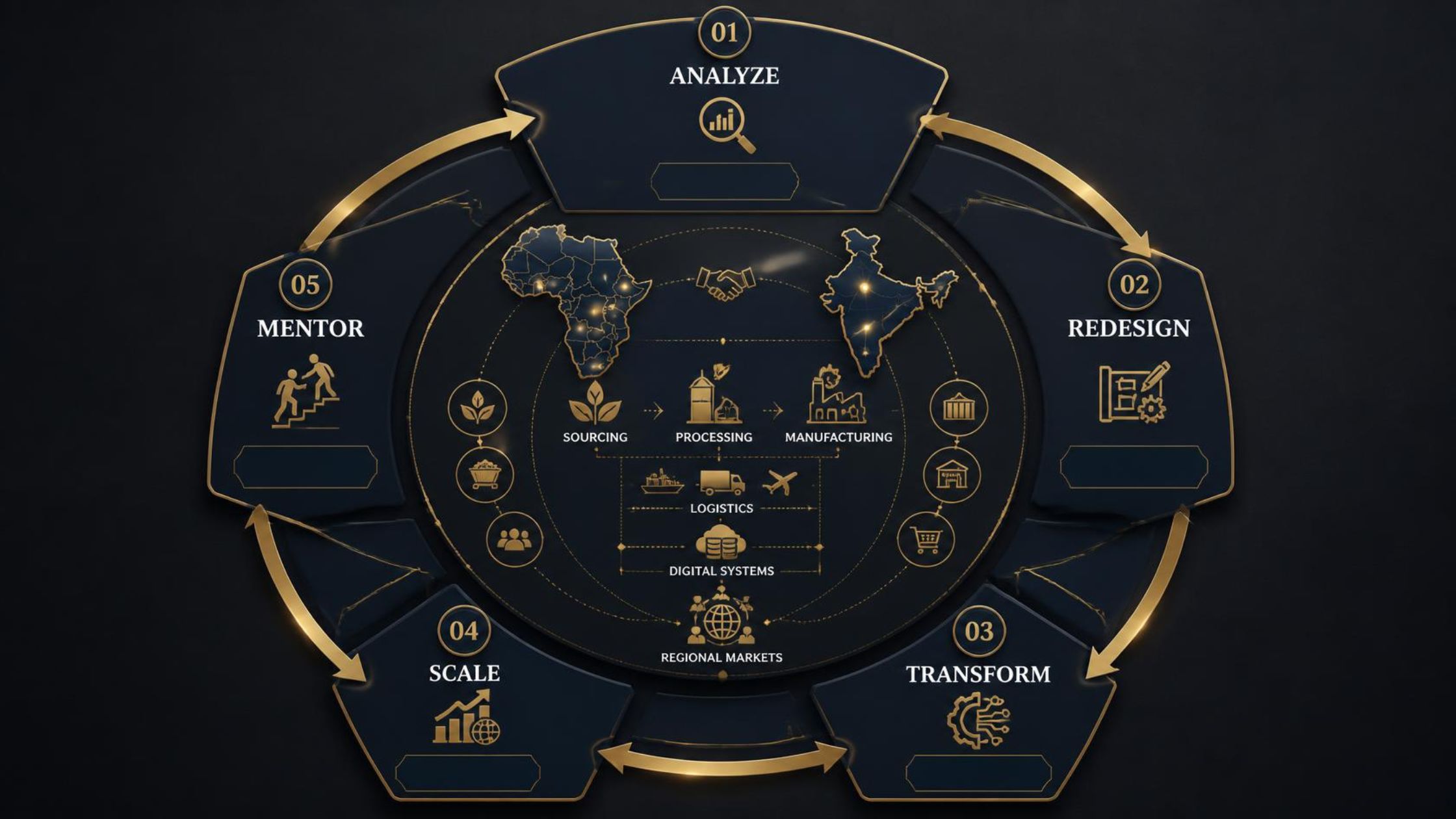
The article introduces the Indo Shinka Advisory Execution-to-Value Architecture, an analytical framework for understanding the journey from strategic intent to measurable result.
The Outlook
Business transformation is increasingly becoming a permanent leadership responsibility rather than a one-time program.
Organizations are simultaneously responding to technology shifts, changing customer expectations, margin pressure, geopolitical uncertainty, new business models, regulatory requirements and changing workforce expectations.
But strategic ambition alone does not create transformation.
Most organizations do not struggle to articulate ambition. They struggle to make that ambition operational.
A transformation may have a compelling strategy, a large investment envelope, an executive sponsor and a detailed program plan—and still fail to produce the expected business result.
Why?
Because strategy does not execute itself.
The transformation must move through a chain of organizational translation:
“How does an organization convert strategic intent into repeated operating behavior and measurable economic results?”
Every transition creates a potential gap.
A strategy can be clear but poorly translated.
A transformation can have ownership but insufficient authority
A program can have funding but lack capability.
Employees can understand the change but continue operating under old incentives.
Projects can be delivered while the business outcome remains unchanged.
That is the execution problem.
Transformation fails when strategic intent is not translated into aligned decisions, accountable ownership, redesigned work, required capabilities, changed behaviors and measurable value realization.
The execution gap is therefore not simply the distance between strategy and implementation, it is the accumulated distance between:
What leadership says should change
and
What the organization actually does differently.
“But, what if transformation does not primarily fail because the strategy is wrong—but because the organization is still designed to execute the old strategy?”
The Strategy Is Not the Transformation
Strategy answers questions such as:
Where are we going?
What will we compete on?
What choices will we make?
What capabilities will matter?
Where will we invest?
What will we stop doing?
Execution answers different questions:
Who makes the decision?
Who owns the outcome?
What changes Monday morning?
Which process changes?
Which capabilities must be built?
Which resources move?
Which incentives change?
Which activities stop?
How is progress measured?
When does the organization know that the change is working?
This distinction is fundamental.
A strategy can be intellectually correct while execution remains structurally incapable of delivering it.
That is why transformation should not be viewed as:
Strategy + Projects
It should be viewed as:
Strategy + Organizational Translation + Execution System + Value Realization
What Is the Execution Gap?
The execution gap is the distance between:
What leadership intends
It should be viewed as:
What the organization repeatedly does.
It can appear in several forms.
Intent vs Action:
Leadership declares a new strategic priority.
The organization continues allocating most resources to legacy priorities.
Decision vs Behavior:
Leadership changes policy.
Decision-making behavior remains unchanged.
Technology vs Workflow:
A new technology platform is implemented.
The underlying process remains essentially the same.
Capability vs Performance:
Training is completed.
The required capability does not appear in day-to-day work.
Transformation Activity vs Business Result:
Projects are delivered.
Revenue, margin, cash flow, customer experience or productivity does not materially improve.
These are different manifestations of the same problem:
The transformation has not crossed the boundary from program activity into operating reality.
The First Failure: Treating Transformation as a Project Portfolio
One of the most common transformation mistakes is to turn transformation into a collection of initiatives.
The dashboard fills with:
projects,
milestones,
workshops,
technology deployments,
training sessions,
process redesigns,
communications,
steering committees.
All of these may be necessary.
None of them automatically constitutes transformation.
The critical question is:
What business outcome will be different because this initiative exists?
If the answer cannot be clearly established, the transformation risks becoming activity management.
Why Good Transformations Stall
1. Too Many Priorities
Organizations often launch transformation with an expansive ambition, where "Everything" becomes important.
When everything is important:
• resources fragment;
• decision cycles lengthen;
• teams become overloaded;
• dependencies multiply;
• accountability becomes diluted.
Transformation requires prioritization. The organization must know what matters most.
2. Weak Ownership
Transformation cannot be owned collectively in the abstract.
Someone must own the outcome.
—Not merely the project. —Not merely the workstream. —Not merely the reporting.
The question should be:
Who is accountable when the expected business result does not materialize?
Outcome ownership is different from project ownership.
3. Decision Rights Do Not Change
Transformation frequently asks organizations to move faster while leaving decision rights untouched.
That creates a contradiction.
If every major decision still requires multiple layers of approval, the organization cannot become significantly more responsive simply because a new strategy says it should.
The strategy and operating model are now in conflict.
6. Change Is Announced Rather Than Embedded
Communication is necessary.
Communication is not transformation.
Employees need to understand:
• what is changing;
• why it is changing;
• what changes in their role;
• what decisions they now make;
• what capabilities they need;
• how performance will be measured;
• what behaviors leadership expects.
The change must then enter the flow of work.
7. Measurement Tracks Activity Instead of Value
A transformation dashboard can be green while the transformation is economically underperforming.
The transformation must connect activity to outcome.
The Seven Execution Failure Layers
The Indo Shinka Advisory's analytical model identifies seven layers.
Layer 1 — Strategy
Is the ambition clear?
Layer 2 — Translation
Has the strategy been converted into specific organizational choices?
Layer 3 — Ownership
Does every critical outcome have an accountable owner with authority?
Layer 4 — Capability
Does the organization possess or build the skills required?
Layer 5 — Operating Model
Are structure, processes, technology, governance and incentives aligned?
Layer 6 — Adoption
Are new behaviors actually being used in daily work?
Layer 7 — Value Realization
Is the organization capturing measurable business impact?
The model is intentionally simple.
Note: It is not a statistically validated framework. It is an Indo Shinka analytical architecture designed to help leadership diagnose where execution is breaking down.
From Strategic Intent to Operating Reality
A transformation should be translated through five questions.
1. What must become different?
Define the target state.
2. What must stop?
Transformation requires subtraction.
3. What must start?
Identify new activities, capabilities and behaviors.
4. Who owns the change?
Assign outcome accountability.
5. How will we know it worked?
Define measurable outcomes before execution begins.
This creates a bridge between strategic ambition and operational reality.
Leadership Alignment Is an Execution Mechanism
Leadership alignment is not a cultural luxury.
It is an execution mechanism.
If the CEO wants speed, the CFO wants control, the COO wants stability and the business heads want autonomy, the organization receives competing signals.
What if transformation does not primarily fail because the strategy is wrong—but because the organization is still designed to execute the old strategy?
This changes the leadership conversation.
Instead of asking:
“Why are people not executing?”
leaders should ask:
“What in our system makes the desired execution difficult?”
That question moves transformation from blame to diagnosis.
A New Leadership Question
The traditional transformation question is:
“Do we have the right strategy?”
The next question should be:
“Have we built the organization that can execute it?”
And the final question is:
“Can the organization sustain the new behavior without extraordinary transformation effort?”
That is where transformation becomes institutional capability.
Indo Shinka Advisory Perspective
Strategy defines the direction. Execution changes the organization. Results prove whether the transformation worked.
For Indo Shinka Advisory, transformation therefore begins with diagnosis rather than activity.
The objective is to understand:
— Where is value being lost?
— What must change?
— What prevents that change?
— How should the organization be redesigned?
— How will the change become repeatable?
That is the difference between announcing transformation and building transformation capability.
Conclusion
Transformation fails in the space between intention and repetition.
— A strategy may create direction.
— A program may create activity.
— A technology platform may create capability.
But sustainable transformation requires something more:
“The organization must repeatedly behave differently—and those changed behaviors must create measurable value.”