Corporate turnaround strategy focused on restoring cash, profitability and value creation, indo shinka advisory, business transformation, smartfive

When Growth Stops Creating Value: The New Turnaround Strategy Playbook

Growth can look healthy while the economics underneath it deteriorate.

Revenue may rise while margins compress, receivables stretch, inventory accumulates, capital expenditure accelerates, customer acquisition becomes more expensive, service complexity expands and management attention fragments.

The company is growing. But it may not be creating value.

That distinction is becoming increasingly important for boards, CEOs, investors and transformation leaders.

Business growth fails to convert into cash flow and value, indo shinka advisory, business transformation, smartfive

Growth Is Not the Same as Value Creation

Revenue is an activity measure.
Value creation requires a relationship among:
  • Revenue quality;
  • Margin;
  • Cash conversion;
  • Capital intensity;
  • Returns;
  • Risk;
  • Strategic capability.
A business can add customers and revenue while simultaneously weakening its economic position.
For example:
  • growth may require excessive discounting;
  • low-quality customers may consume disproportionate service resources;
  • inventory may rise faster than sales;
  • receivables may lengthen;
  • capacity may be added ahead of demand;
  • technology investments may not translate into productivity;
  • organizational layers may multiply;
  • capital may move toward lower-return businesses.
The result is a dangerous contradiction:

“More business activity, but less economic value.”

Business growth fails to convert into cash flow and value, indo shinka advisory, business transformation, smartfive

The Turnaround Begins Before Distress

Traditional turnaround thinking often begins when the situation becomes visibly severe.
  • Cash Flow becomes tight.
  • Lenders become concerned.
  • Suppliers tighten terms.
  • Employees become uncertain.
  • Management starts discussing restructuring.
But value leakage frequently begins much earlier.
A company may already be experiencing:
  • declining return on capital;
  • weakening free cash flow;
  • pricing leakage;
  • customer concentration;
  • working-capital deterioration;
  • product proliferation;
  • declining productivity;
  • excessive overhead;
  • low-return capital expenditure;
  • poor portfolio economics.
The opportunity is therefore to move turnaround thinking upstream.

“Performance Drift → Value Leakage → Strategic Stress → Liquidity Pressure → Formal Distress”

The earlier intervention occurs, the more strategic options management may retain.
The First Question for leadership IS NOT:

“What Should We Cut?”

It actually IS:

“Where did the economic engine stop converting growth into value?”

That question changes the turnaround strategy.
Instead of beginning with a generic cost-reduction program, management begins by establishing economic truth.
The diagnostic should examine:
  • customers;
  • products;
  • channels;
  • geographies;
  • business units;
  • plants;
  • suppliers;
  • working capital;
  • pricing;
  • capital expenditure;
  • organizational structure;
  • technology;
  • cash generation.
The goal is to identify the actual sources of value creation and value destruction.
13-week cash flow and business economics turnaround assessment, indo shinka advisory, business transformation, smartfive

The 13-Week Cash and Economic Truth

Liquidity is often the immediate constraint.
A disciplined turnaround strategy should therefore establish short-term cash visibility.
But cash forecasting alone is not enough. The organization also needs to understand why cash is behaving the way it is.
The diagnostic should connect:

“Cash → Customers → Products → Operations → Working Capital → Capital → Strategy”

A 13-week cash view should therefore sit alongside a broader economic diagnostic.
Questions include:
  • What cash is contractually committed?
  • Which receivables are collectible?
  • Where is inventory accumulating?
  • Which payments can be rescheduled?
  • Which suppliers are strategically critical?
  • Which customers generate cash?
  • Which contracts consume cash?
  • Which investments are essential?
  • Which investments can be delayed?
  • Which businesses require disproportionate capital?

Stabilize Without Destroying the Engine

Cost action can be necessary.
But indiscriminate cost cutting can damage the very capabilities required for recovery.
Potentially damaging cuts may include:
  • critical sales capacity;
  • maintenance;
  • quality;
  • technology;
  • customer service;
  • essential talent;
  • product development;
  • compliance;
  • supply-chain resilience.
Potentially damaging cuts may include:
“Selective protection + aggressive removal of non-value-creating complexity.”
The question is NOT:

““Where can we cut?””

It IS:

“Which expenditure protects future value, and which expenditure consumes value without creating it?”

Working capital turnaround releasing cash from inventory and receivables, indo shinka advisory, business transformation, smartfive

Working Capital Is an Operating Issue

Working capital is often treated as a finance topic.
In a turnaround, that is too narrow.
Inventory may reflect:
  • poor demand planning;
  • excessive SKU complexity;
  • procurement behavior;
  • production batch sizes;
  • weak inventory governance.
Receivables may reflect:
  • poor billing;
  • contract disputes;
  • weak collections;
  • poor customer selection;
  • inadequate credit controls.
Supplier balances may reflect:
  • procurement structure;
  • commercial terms;
  • supplier concentration;
  • planning failures.
Therefore:
“Cash release should address both the balance sheet and the operating causes behind it.”
Portfolio strategy review for corporate turnaround and value creation, indo shinka advisory, business transformation, smartfive

Re-Underwrite the Portfolio

Remember:

Not every product deserves equal investment.

Not every customer deserves equal service intensity.

Not every geography deserves equal capital.

Not every business unit deserves continued expansion.

Leaders should understand:
  • contribution economics;
  • cash intensity;
  • strategic relevance;
  • future potential;
  • capital requirements;
  • risk;
  • management complexity.
Potential strategic actions include:
“Grow → Fix → Partner → Harvest → Simplify → Exit”
These are not generic prescriptions, but they are decision categories requiring company-specific analysis.
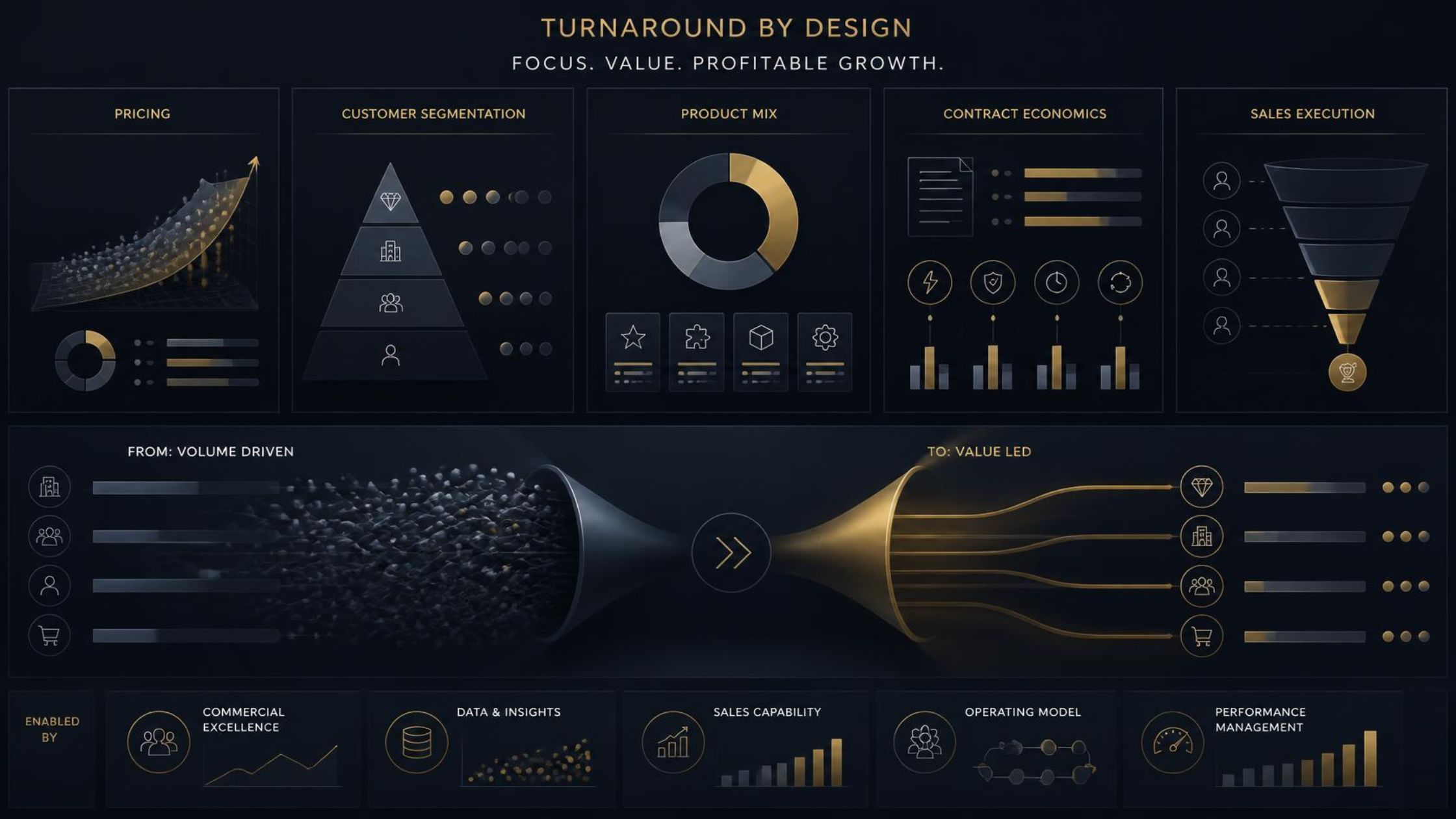
Commercial turnaround focused on pricing, customer mix and profitable growth, indo shinka advisory, business transformation, smartfive

Restore Commercial Quality

A turnaround still needs revenue.
But revenue at any price is not necessarily attractive.
Commercial value can be damaged by:
  • excessive discounting;
  • poor pricing discipline;
  • unprofitable contracts;
  • excessive customization;
  • high service costs;
  • poor customer mix;
  • weak retention;
  • misaligned sales incentives.
Commercial turnaround strategy should therefore connect:
“Pricing + Product + Customer + Channel + Service + Sales Incentives”
The objective is not simply to increase sales.
It is to increase economically attractive sales.
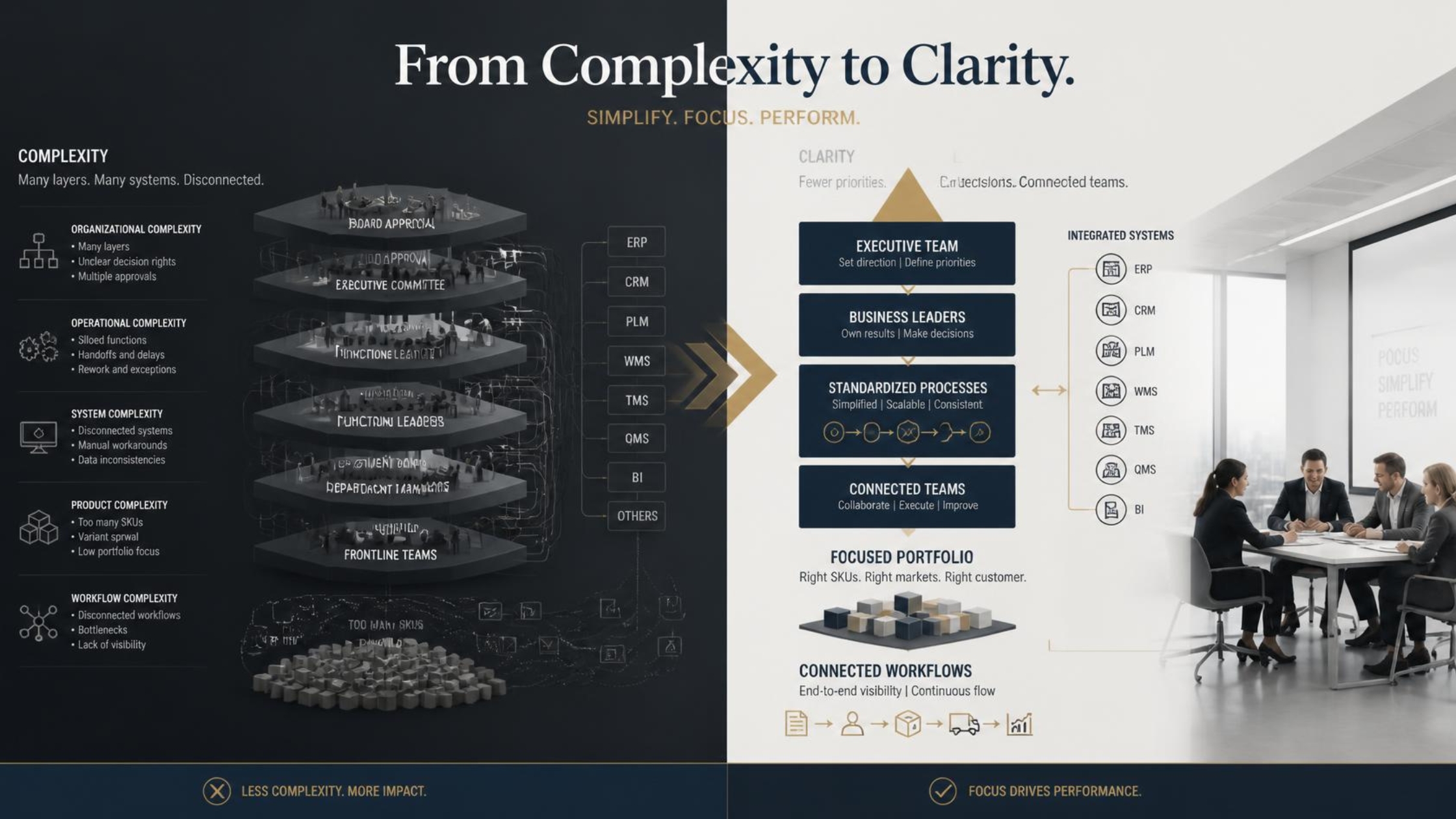
Operating model simplification during a corporate turnaround, indo shinka advisory, business transformation, smartfive

Simplify the Operating Model

Complexity has a hidden economic cost.
Too many:
  • products;
  • systems;
  • approvals;
  • organizational layers;
  • suppliers;
  • locations;
  • processes;
  • exceptions;
  • priorities
can consume enormous management capacity.
Simplification becomes a value lever.
The aim is:
“Fewer priorities → clearer accountability → faster decisions → lower complexity → better economics.”
Turnaround value bridge from performance leakage to sustainable value creation, indo shinka advisory, business transformation, smartfive

Performance Management Must Shift to Value Drivers

Turnaround programs often fail because they create a large list of initiatives without a clear value bridge.
Each major initiative should identify:
  • baseline;
  • action;
  • owner;
  • timing;
  • expected value;
  • cash effect;
  • investment required;
  • risk;
  • verification method.
The organization should track: Realized Value
rather than simply: Completed Activities
That distinction is fundamental.

Stakeholder Alignment Matters

A well-designed Turnaround Strategy rarely involve management alone.
Relevant stakeholders may include:
  • board;
  • shareholders;
  • lenders;
  • employees;
  • customers;
  • suppliers;
  • regulators;
  • strategic partners.
Each may have different expectations regarding:
  • timing;
  • risk;
  • liquidity;
  • investment;
  • restructuring;
  • recovery.
A credible turnaround strategy creates a shared fact base and transparent sequence of decisions.
Where formal restructuring or insolvency becomes relevant, specialist legal, financial and regulatory advice should be obtained.
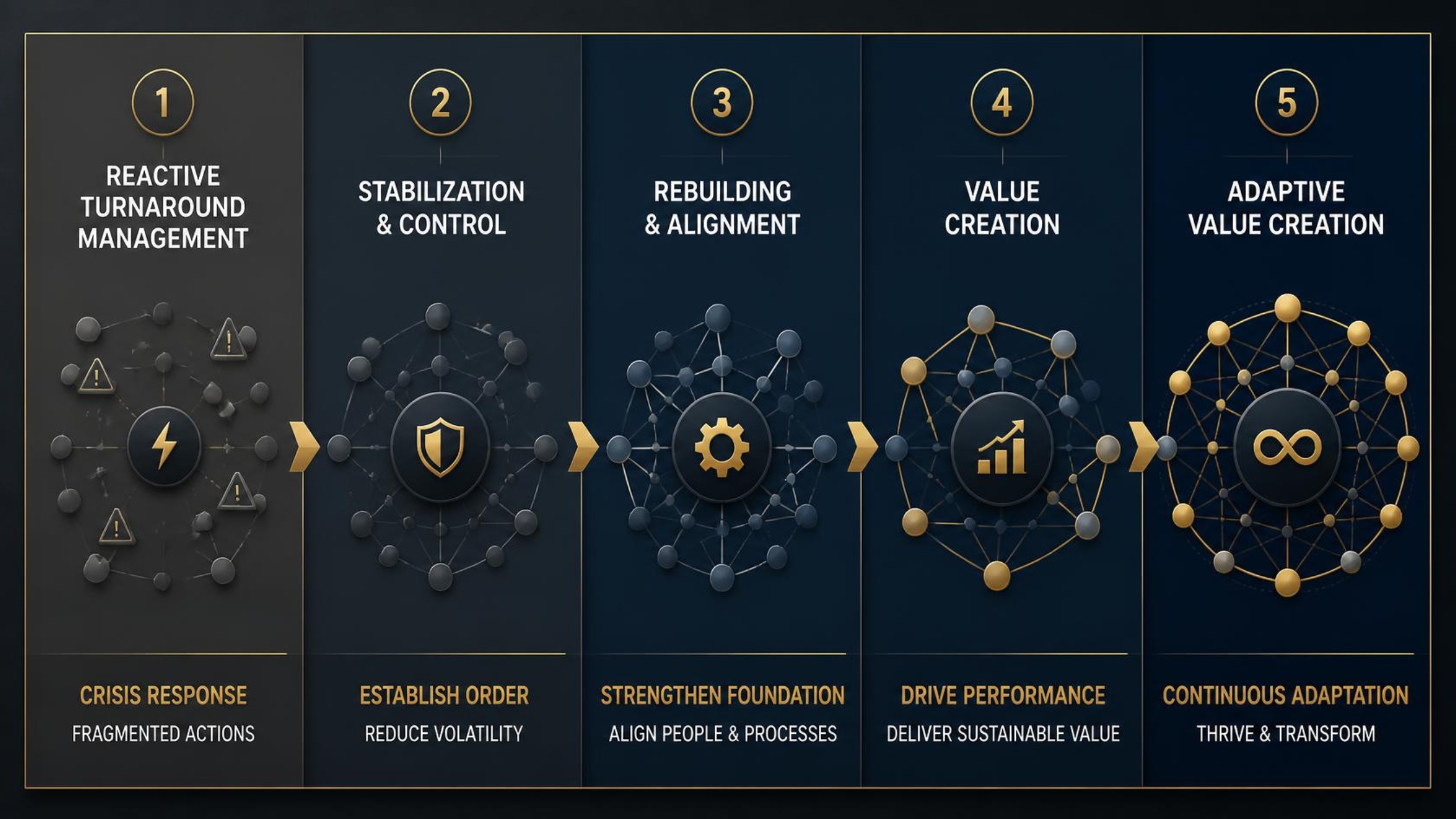
Five-stage corporate turnaround maturity model from reactive to adaptive, indo shinka advisory, business transformation, smartfive

From Turnaround to Reinvention

Stabilization is not the finish line.
Once liquidity and operational reliability improve, management should revisit the underlying business model.
Questions include:
  • Where should the company compete?
  • What should it own?
  • What should it outsource?
  • Which capabilities are genuinely differentiating?
  • What should technology change?
  • Which customers deserve greater investment?
  • What should the capital-allocation model become?
  • What organizational structure supports the next phase?
The turnaround should ultimately produce a better business—not merely a less distressed one.

The New Turnaround Strategy Playbook

1. Diagnose

Establish economic and operational truth.

2. Stabilize

Protect liquidity and critical operating capability.

3. Focus

Prioritize customers, products, businesses and markets.

4. Repair

Fix working capital, pricing, productivity and execution.

5. Rebuild

Redesign the operating and commercial model.

6. Scale

Expand the economics that work.

7. Institutionalize

Build management routines that prevent value leakage from returning.

Seven Leadership Questions

1. Where exactly is growth failing to translate into cash, margin or return?

2. Which customers, products, geographies and businesses create economic value after fully loaded costs?

3. How much cash is trapped in working capital—and what operating causes created it?

4. Which costs are structural, which are temporary and which protect future growth?

5. What should the organization stop doing, simplify, redesign or exit?

6. Which decisions require tighter ownership, faster escalation or different incentives?

7. What must change so that today’s turnaround does not become tomorrow’s recurring crisis?
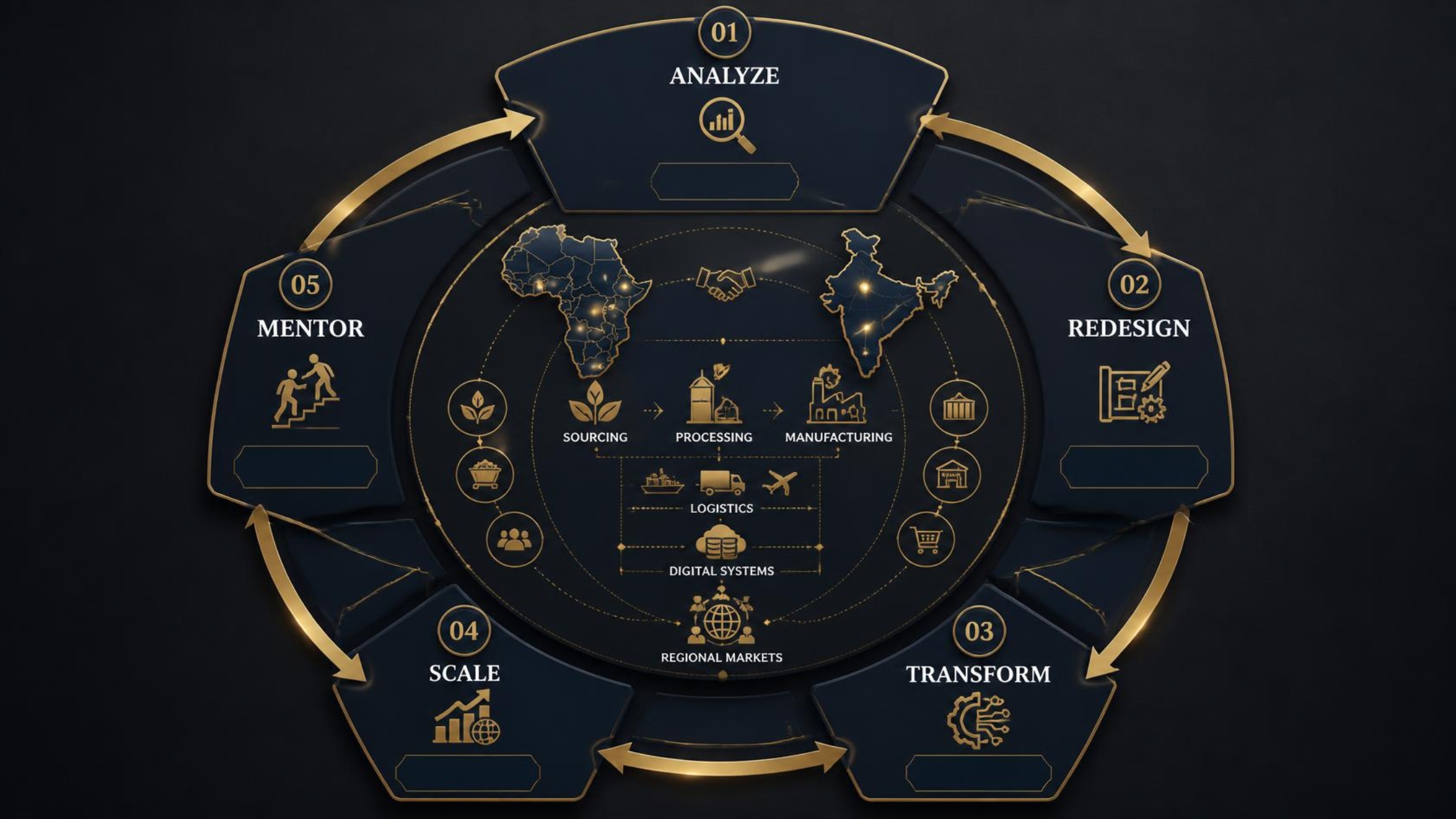
SmartFive transformation cycle applied to corporate turnaround strategy, indo shinka advisory, business transformation, smartfive

SmartFive™ Framework

Analyze

Diagnose liquidity, economics, portfolio, operations and value leakage.

Redesign

Reset portfolio, commercial model, operating model and capital allocation.

Transform

Execute the highest-value changes with clear ownership and governance.

Scale

Institutionalize new economics, processes, metrics and capabilities.

Mentor

Build leadership routines that continuously detect and correct performance drift.

Conclusion

When growth stops creating value, the answer is not automatically slower growth.
It is better growth.
Growth that creates:
  • cash;
  • attractive returns;
  • resilient operations;
  • strategic capability;
  • customer value;
  • sustainable competitive advantage.
The strongest turnaround is therefore not simply a recovery from distress.
It is the restoration of economic logic.
And the creation of a management system that prevents value leakage from becoming the next crisis.

Indo Shinka Advisory

Strategic Business Transformation & Turnaround Experts

Group Entities

Expressions

Indo Shinka Advisory

Strategic Business Transformation & Turnaround Advisory | India | Africa | Middle East and beyond.